
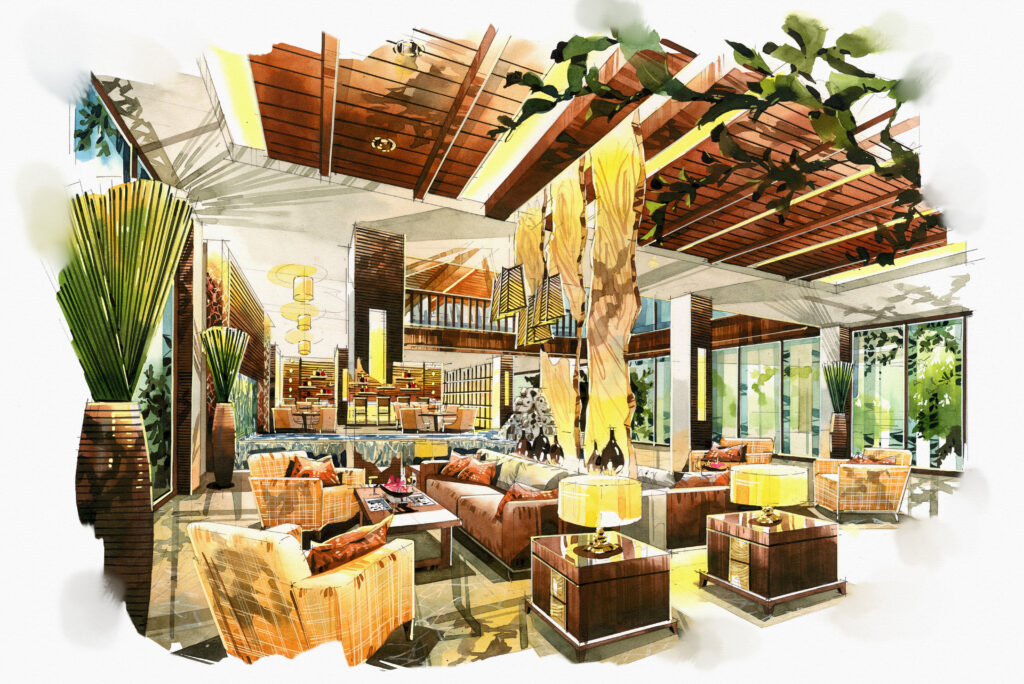
The evolution of a hotel’s primary public space
By A.D. Thompson
Times were once that the lobby of your hotel was a ‘just passing through’ kind of space. A space for check-in and check-out. A stop to hit the ATM. The gateway to your room and your destination, but not much more.
Times have changed.
Hotel lobbies have morphed from functional to fabulous. They’ve become workspaces and watering holes. They’re more tech-forward and flexible than ever, showcasing the destinations they represent, and their brands, with beautiful, thoughtful design.
“When that guest walks into the lobby, that’s the first impression of the hotel,” said Hitesh (HP) Patel, chief operating officer of Curve Hospitality, a Silver Industry Partner. “They want to see something open and vibrant and clean.”
The lobby is so vital, in fact, “that we always tell our clients that if they’re not planning on doing full property renovations, at least do the lobby space, because that’s where the majority of your guests will enter and exit, do breakfast or, if you have a bar and lounge, it’s another revenue stream you can incorporate.
“It’s crucial,” he said plainly.
And he would know. Pre-COO status, the former AAHOA Chairman was a Curve client, whose own properties benefited from the company’s expertise. Curve not only specializes in custom manufacturing, its in-house interior design team is all-hospitality, all the time.
Seating. Lighting. Wall coverings. Artwork. These, along with other features, are points to discuss when his teams are meeting with owners and managers about what they envision for the property.
Back in 2019, as HP’s chairmanship was winding down, he was poised to return to the day-to-day of managing his properties, a part of which, perpetually, is renovation. Amid the process, his longtime partners at Curve floated a test balloon.
“They were looking for someone to take the company to the next level,” he said.
The renovations took priority at the time, but soon after, he joined the team. Six years in, Curve has grown exponentially.
“We’ve created three different verticals within the company and have a staff of over 75 people at our offices in Houston.”
They’ve also opened additional outposts in Canada, India, and The Bahamas.
HP’s experience as an owner, of course, is key in aiding clients. And, checking out the competition, he said, can be eye-opening.
“Owners often become complacent,” he explained. “They don’t go look at what else is available … they don’t want to spend XYZ to renovate, and they’re losing market share.”
Curve’s team often does the recon for clients, gathering intel from the competitors and the changes they’ve made to improve their own spaces.
Designing a Third Space
“The lobby is really its own third space these days,” said Priyank Patel, owner of the Red Roof Plus in Manassas, VA, and AAHOA Washington DC Area Regional Director.
“It’s a place that has transitioned, a place where networking happens,” he said. “When I go to conventions and events, there’s usually something going on in the banquet facility, but the lobby is where we meet and greet people and build connections.”
An engineer by trade, Patel comes from a hospitality family, and when he emigrated to the U.S. from Canada, an ownership opportunity presented itself. The twin lures of making his own schedule and the returns of ownership made it one he couldn’t refuse.
Patel’s own property is economy class, but even here, he said, the lobby is the first impression the guests have.
“It sets the tone for how the guests envision their stay will be … and since we took over the hotel, we’ve made a lot of changes while respecting the brand standards but also adding a creative and personal touch.”
Wallpaper with cherry blossoms to bring to mind its Washington, D.C. market location, he said, helps connect guests with the destination and its proximity to the nation’s capital.
In smaller properties, where a full bar isn’t possible, a mini-bar with refreshments and sundries is a nice touch, as well as a place for people to congregate, even for a short time, like a fireplace where colleagues or couples can gather.
“Cozy furniture for a minimum of four or five people, a spot where they can sit, network, talk,” Patel said.
Convenience and tech-features – a business center, charging ports – are a must, as well.
Today’s lobby design is an about-face, said HP, from the COVID-inspired pullback from social spaces, and some properties have lagged behind.
“The Instagram walls and grab-and-go concepts and bars went away and even afterwards, nothing really opened back up because of operational issues. You couldn’t find anyone to staff them,” HP said.
Hotel occupancy has been down year over year, he pointed out.
“This year I think we’re down 30 percent nationwide,” he said. “Owners have to create a different revenue stream.”
Pop-up restaurants and bars have been a good fix, driving more local people to come check out the property. And bars themselves are coming back, even in unexpected venues.
“You have Hampton Inns and Fairfield Inns putting bars in their hotels now, because that little breakfast area is only used for three hours a day,” HP said. “Why not convert it into a flex-space where you can have a bartender and sell beer and wine? You don’t even have to have liquor.”
Breakfast spaces that can double as happy-hour meetups are just one example of how savvy owners and the designers that help them are crafting post-COVID comebacks for the lobby.
Furniture, of course, plays a big role.
“Big communal tables with a lot of seating can become meeting spaces or locations where guests can comfortably cowork,” said HP.
So, too, does color.
“It’s vibrant,” he continued. “The reds, the greens, the burgundies … it just depends on the owner’s vision.”
Even properties with brand affiliation are looking to customize and capitalize on things like unique architectural features or perks of the destination.
“Think of a college town, like Auburn,” he said as an example. “You know that guests are going to be visiting for games, so brands are given more leniency to lean into that with color schemes that reflect it.”
Technology isn’t just about the hardware your guests might need, but is facilitating the process of the renovation, making it much easier to achieve the flow the space needs.
“We have clients coming to the office where they can actually put on the VR goggles and walk around their own lobby,” HP explained. “If they don’t like a chair in a certain place, we can move it right then.”
Products like Canva and Revit allow for complete customization that people can visualize beyond the dream boards and fabric swatches of the past.
Modernization and a real interest in what guests are using is making moves to their rooms, of course (steamers in place of irons, clean shelving instead of clunky end tables) but same goes for the lobbies where even brands like Ritz-Carlton are leaving old-school, traditional looks behind … and paying attention to all the senses.
“Smell is a big thing,” HP chuckled. “And music playing in the background.”
But what it offers is still the key.
“You could have the best-looking lobby in town,” he said, “but if there’s not a reason for guests to be down there, they won’t be.”
Image: last19/stock.adobe.com
Leave a Reply