
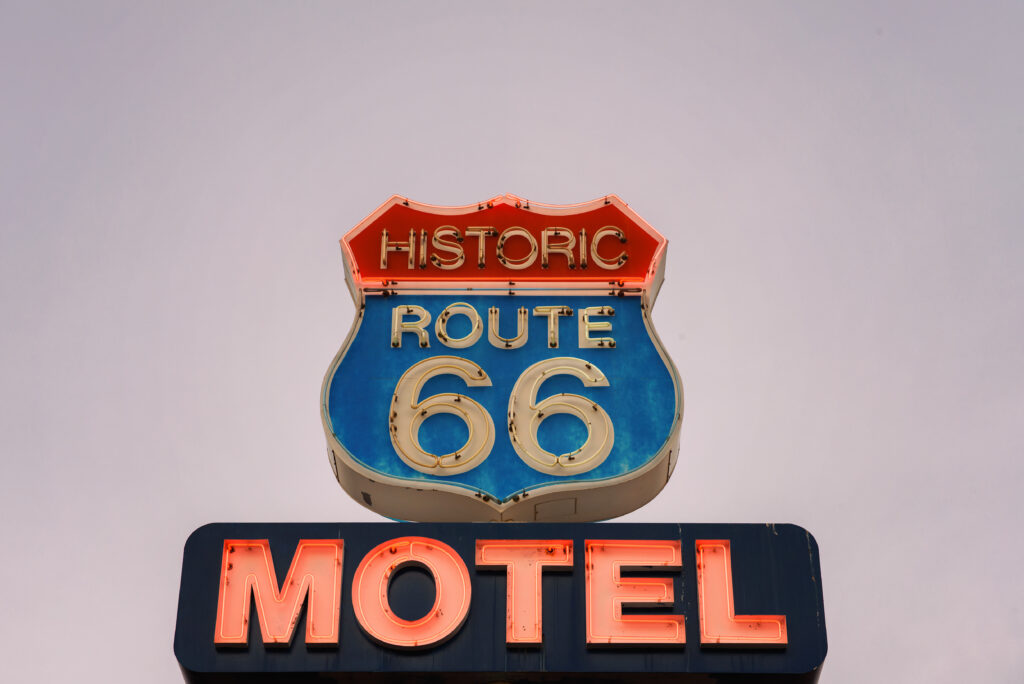
Hospitality on Route 66, then and now
By Cathleen Draper
One hundred years ago, the U.S. Bureau of Public Roads created the first federal highway system in an effort to connect small, rural towns with the urban centers between them. The system included an east-west network of existing local, state, and national roads running almost diagonally from Chicago to Santa Monica, CA.
That 2,448-mile stretch of roads – spanning Illinois, Missouri, Kansas, Oklahoma, Texas, Arizona, New Mexico, and California – was officially designated as U.S. Highway 66, or Route 66.
In its early days, Route 66, coined the “Mother Road” by author John Steinbeck, served as a passage to opportunity as the Great Depression and the Dust Bowl sent economic and environmental refugees west in hopes of finding work in the region’s emerging industries. It made travel between rural communities and the industrial hubs in larger cities easier, and as automobile ownership grew among families, tourists set out to explore the American West.
During the 1920s and early 1930s, auto camping served as the primary form of lodging along the road; these were designated areas where travelers could park their car and camp for the night. Local families also rented out spare rooms, calling themselves “tourist homes.”
Auto camps gave way to cabin camps, or cottages, and auto courts, where travelers parked adjacent to their individual cabins. Eventually, these evolved into motels, a portmanteau of “motor” and “hotel” – a single-floor building housing all rooms, with parking spots in front of each. Often, motels had restaurants, souvenir shops, and service stations on the same property. The model stuck.
The rise of motels coincided with Route 66’s development; when it was designated as a highway, much of it remained unpaved. But in the mid1930s, Route 66 was a target of the New Deal’s Civilian Conservation Corps and Works Project Administration, which employed Americans in public lands conservation and infrastructure. In 1938, it became the first highway to be completely paved, according to the Federal Highway Administration.
Though tourism declined in the years that followed as Americans endured World War II and faced rations on fuel and tires, Route 66 became a primary route for moving military equipment, materials, and troops across the country, bridging the Midwest’s industrial hubs with California’s ports.
In the decade after WWII ended, car ownership exploded – in 1955, some 52.1 million cars were registered, more than double the amount 10 years prior. With more leisure time and money, families embarked on what’s become known as the “Great American Road Trip,” seeking the adventure that Bobby Troup sang of in his 1946 song, “Get Your Kicks on Route 66.” Millions traversed the highway, visiting the Grand Canyon, Disneyland, Southern California, and other scenic attractions, staying at motels along the way.
The ‘50s and early ‘60s encompass the era so many envision when they think of Route 66 – happy families, mom-and-pop businesses, roadside kitsch, and an endless sea of colorful neon signs beckoning travelers to this diner or that attraction or this motel.
That was the route’s peak. But at its height, the U.S. began to develop a national system of interstate highways which, by the late ‘60s and early ‘70s, offered faster, more straightforward routes between urban centers, ultimately leading to the road’s demise. The U.S. officially decommissioned Route 66 in 1985.
Route 66’s Modern Hotel Culture
Though many of the route’s original, neon-bedecked motels are no longer operational today, hotels along and adjacent to the route continue to welcome guests, offering amenities, nostalgia, and modern hospitality to today’s road trippers.
AAHOA Lifetime Members Kevin and Ginger Nelson and their partners own several hotels in Amarillo, the largest city on the 178-mile stretch of Historic Route 66 that spans the Texas panhandle. The highway runs through the heart of the city’s downtown, where one of their hotels, a Courtyard by Marriott, is housed in the Fisk building, which was constructed just two years after Route 66’s official designation. The building, which is listed on the National Register of Historic Places, is a little less than two blocks south of Route 66.
Four of their five hotels in Amarillo sit directly off the historic highway. When they opened a My Place Hotel in 2016, the guests the property saw in the first two months of business were a testament to Route 66’s continued draw.
“In our first 40 days we had visitors from 40 states, which I thought was remarkable,” Kevin Nelson said.
His Tru by Hilton property is a modern evolution of the motels that once dotted Route 66 – vibrant and colorful with a rock garden where guests leave their mark with hand-painted rocks. The hotel’s guest list runs the gamut, from history buffs to international visitors, motorcycle groups, road-trippers, and families, all seeking to experience a piece of American history.
The Tru’s general manager, Lacey Wortman, enjoys working front desk shifts for the opportunity to meet so many different people, especially as Route 66 celebrates its centennial.
“I’ve been working some three-to-11s, because those are the shifts when we can talk the most, so I’m excited to ask people what brings them to Amarillo,” she said.
Wortman prides herself on offering the same hospitality and care that has been provided along Route 66 since its hey-day. She directs travelers to the best of what Amarillo and its stretch of Route 66 have to offer: The Palo Duro Canyon; The Big Texan, a steakhouse that opened in 1960, spotted by its towering neon sign; GoldenLight Café, which has operated on Route 66 since 1946; and Cadillac Ranch, a public art installation of 10 half-buried vintage Cadillacs covered in graffiti. Visitors are encouraged to add to the layers of spray paint.
“We actually have some cans of spray paint in the front desk drawer, so that when they go out there, ‘here’s a can of spray paint,’” she said.
Roughly 1,000 miles away, AAHOA Member Shyamal Patel takes similar pride and care in operating a Studio Six/Motel Six dual-branded property on Route 66 in Victorville, CA. His primary market is travelers making the trek along the state’s stretch of the historic highway.
“Victorville has always been an important stopping point,” Patel said. “Historically, travelers needed a place to rest before continuing through the desert. Victorville’s Route 66 heritage is a source of pride, and we’re honored to welcome travelers who come here to experience that history firsthand.”
Patel’s team always recommends guests check out the Route 66 Museum and Old Town Victorville, the historic city center which boasts mid-century signs, historic diners, and a neon archway that reads “Old Town Route 66.” Emma Jean’s Holland Burger Café, a still-operational diner from 1947, and Elmer’s Bottle Tree Ranch, a kitschy collection of 200 bottle trees just off the highway, are two more nearby attractions.
These local establishments are incredibly important to preserving Route 66, Patel said, especially because today’s road trippers actively seek out mom-and-pop businesses.
“We’re the ones sharing the stories and welcoming visitors,” he opined. “Every hotel, restaurant, museum, and small business along Route 66 helps keep the history alive for future generations.”
Patel hopes to also highlight that history in the walls of his hotel. It’s currently under renovation, and he plans to design an entire floor of Route 66-themed rooms. His goal is to attract guests like those who traveled the route more than 70 years ago: Travelers seeking a positive, affordable, and family-focused accommodation. An Instagram and TikTok-friendly area in the banquet hall will ideally further that connection for the younger generation.
The Mother Road’s Legacy
At its peak and in the years that followed, Route 66 has served as more than just a highway. It’s offered the freedom of the open road and the opportunity to choose one’s own path. The highway continues to capture the imagination of people across America and around the world today.
“Route 66 is not just a highway – it is a story that is still being written every day,” Patel said.
Hotel owners, Nelson said, want to give travelers seeking new experiences and frontiers an authentic connection not just to the highway, but to the communities that define it and the generations they’ve spanned.
“The reason why people got their kicks on Route 66 is because it’s interesting, and much of the fabric, the things that people saw 100 years ago, you can still see. It’s the same Palo Duro Canyon, the same sites. It’s alive, it’s well, and the stories are still being told.”
Last year, Nelson’s son moved to Chicago, where Route 66 begins. He, his wife Ginger – the former mayor of Amarillo – and his son drove there from Amarillo, following the path of Route 66. One of the reasons he feels it is important to recognize the highway’s centennial is because it helps to tell the American story. He also connects it to the story of AAHOA Members and their families.
“Some of the pioneers that were part of the AAHOA community, the risk that they took, the motels that they didn’t just buy, they moved into – the whole family lived there,” Nelson said. “They tried something. It just is a great embodiment of what it means to be an American and what it means to be on Route 66.”
Like Nelson, Patel has also driven stretches of the historic highway. He described the feeling as one of awe and peace.
“You’re in the desert, there are mountains, and it’s just an open road and no buildings anywhere,” Patel said. “There’s no chaos around you, and you’re free from any stressors. It feels like America.”
He hopes those that stay on his property take away one lesson from their road trip: That Route 66 is more than a highway; it’s a network of communities and people who work hard to preserve its history.
And his advice for those hitting the Mother Road? “Take your time on Route 66. The journey is just as important as the destination.”
Image: VectorMine/stock.adobe.com
Leave a Reply