
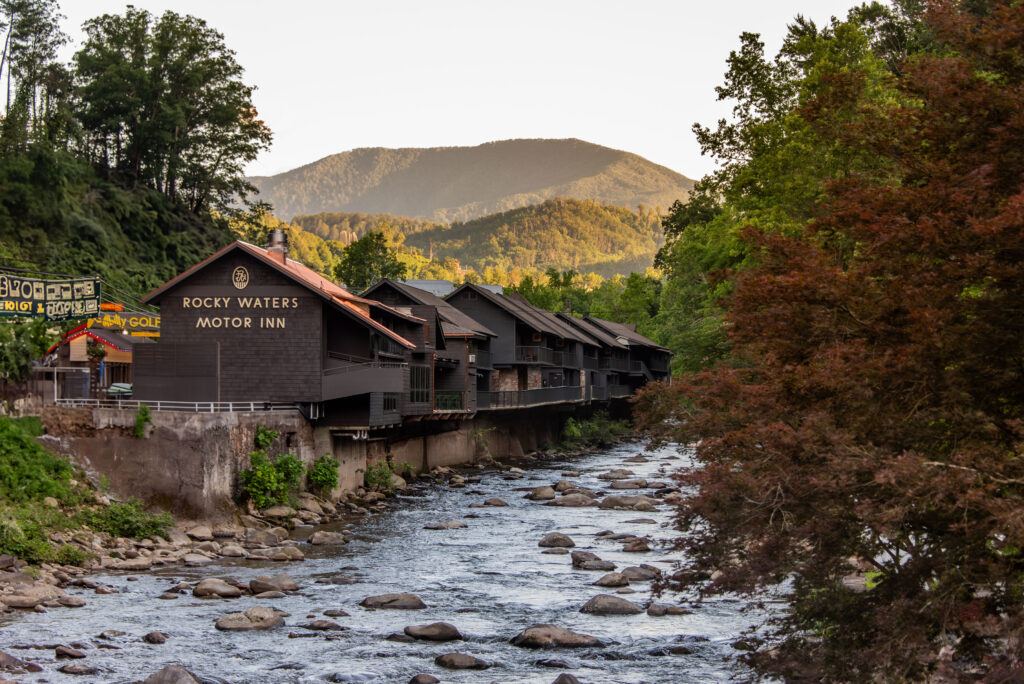
The transformation of the Historic Rocky Waters Inn
By Cathleen Draper
In 2005, Mahavir Patel’s family purchased the Rocky Waters Motor Inn, a historic property in the heart of Gatlinburg, TN, a mountain town on the precipice of Great Smoky Mountains National Park.
The motel opened its doors in the 1930s – roughly a decade before Gatlinburg was officially incorporated in 1945. When Patel, CEO of investment, development, and management firm AATMOS, and his brother Dev, the firm’s CRO, assumed proprietorship of the historic property, it was operating as a one-star motel, a generational family getaway long past its prime.
What started as a one-story structure in the 30s was built upon multiple times over three decades, until six distinct buildings were compiled into one rag-tag motel. The building hangs directly over West Prong Little Pigeon River, and it looked its age.
“It was basically falling apart from the inside out,” Patel said. “Multiple plumbing systems, multiple electrical systems, built on the river. Part of the old pool – which we tore down – within a year would have fallen into the river and taken half the property with it.”
Patel explored the possibility of demolishing the existing structure, starting from scratch with a redevelopment in the same footprint. But a rebuild would prove futile – the motel sits in a FEMA floodway, meaning new development was a no-go.
Yet, the Patels saw an opportunity. With motel conversions on the rise, and a local market saturated with select-service and mom-and-pop operations, there was room to do something different.
“There was a white space for luxury,” Patel said. “We took the risk and made it happen, not knowing what we were getting into. It took triple the time and double the budget. But in the end, it was transformational to the property and transformational to the area.”
The Patels are familiar with evolution. AATMOS grew from a family-operated business into a professionally managed, GP-led platform vertically integrated with investment, development, and management. The company’s practice is shaped by a simple belief: True value is created not just through acquisition, but through how an asset is conceived, repositioned, and operated over time.
The Gatlinburg project is the second major renovation for AATMOS, and it marked a turning point. Unlike other motel conversions, it wasn’t just a renovation, but a full repositioning. The Patels reimagined the property from concept and design to brand strategy and operations.
Part of the property’s metamorphosis included narrowing the motel’s scope. In its past life, “it was a generational place to stay,” Patel said – Gatlinburg is famously family friendly. But many guests that came as children weren’t returning as adults, and Patel pinpointed a need for a more mature, adults-only space.
In partnership with Dryden Studio, a Nashville-based architecture and interior design studio, Tarun Kapoor of Kapoor & Kapoor Hospitality Consultants, and Ashley Parrott of AEP Consulting, AATMOS crafted a new experience in Gatlinburg, one that goes against the grain. From rocking chairs poised on the balconies overlooking the river to an in-room bourbon and whiskey tasting experience, each detail reinforces the hotel’s upscale new life.
Today, it’s a sophisticated, four-star destination that leads the market: The Historic Rocky Waters Inn.
A New Life
When Nick Dryden of Dryden Studio first saw the property, he was struck by the building’s physical presence. Long and narrow, the structure sits close to the road while hugging the river, winding along its curved path.
“Everything about the property is super unique, in a sense that every bit of it is non-conforming to what’s even possible to build in Gatlinburg these days,” said Dryden, principal of the firm. “We gave the building a personality of this snake in the woods. That identified the building with a certain personality that we then took cues from in making intentional design interventions.”
To start, the design team incorporated a slatted wooden wall along the street-facing side of the property’s second floor corridor, which connects the guest rooms. The screen unifies the property, provides an extra layer of privacy from vehicle and pedestrian traffic, and serves as a structural remediation to many of the two-story property’s second-floor woes, bracing the exterior walkways from the top by tying into the roof’s structural system.
“It’s also this new skin on the building, a reference to the snake in the woods shedding his skin and growing a new one,” Dryden said. “The building is this ever-evolving thing, and we approached it like this is the next natural evolution of the building.”
They incorporated cobblestone pavers in the drive, bringing the building back in time to its roots. Some elements, however, had to be brought to the present – the property required extensive adjustments to meet modern building and fire codes, as well as accessibility requirements.
Working within the property’s original footprint limited the possibilities for expansion in the guest rooms, but the Dryden team and Patel chose to vault the second-floor room ceilings, adding rustic wood beams.
Because the inn is adults-only, guest rooms feature a single king bed, and fireplaces bring warmth and coziness. The design team sought inspiration from the Smoky Mountains and all they have to offer – hiking, backpacking, and fishing, to name a few activities – and incorporated natural woods, walnut tones, leather, and rich pine greens and watery blues in the color palette. Each room features a balcony – and premium rooms boast soaking tubs, too – overlooking the river.
“This hotel is designed to be an oasis, a place of respite and retreat,” said Maria Meyer, director of interior design at Dryden Studio. “It puts a lot of emphasis on your personal experience.”
The design team also infused the inn’s design with history. At their initial meeting, Patel brought the designers together with the property’s original owner, who showed family photo albums and walked the team through the motel’s history – the room where he was born, stories of growing up there, and tales of the restaurant he and his mother ran back in the day.
“We were lucky enough to get a huge stack of historic photographs and postcards from the previous owner,” Meyer said. “That was a huge influence of being able to look back and see this very tangible printed history of the building. And that came into play.”
For instance, in the lobby, they took imagery from the historical artifacts and turned it into wallpaper. Family photos are hung throughout the building.
The design team also looked back to 1930s Tennessee for inspiration – barn quilt-inspired art hangs on the balconies, historical folk art is layered throughout the hotel, and wooden furniture is handhewn, with less refinement, hearkening to an era of homesteads.
Overall, the Historic Rocky Waters Inn is grounded in its place, history, and comfort.
“We didn’t try to go over the top in terms of conventional luxury design,” Patel said. “It needed to feel very of-the-place and homey. It needs to be very Gatlinburg – more of a mountain, residential type of feeling.”
The Evolution Continues
The Historic Rocky Waters Inn has made its mark. After opening at the end of June in 2024, the property took off, fully ramping up in roughly six months. It’s already been recognized by the Michelin Guide.
That’s partly thanks to its elevated design, but also its experience. Guests receive a healthy dose of Appalachian hospitality through two dedicated innkeepers assigned to each room who manage the guest experience. Small details such as a library with books detailing the history of Gatlinburg and the region win guests over. And the property’s restaurant, The Heirloom Room, was brought back to life after its purchase from the original owners, now offering upscale Appalachian cuisine.
The restaurant honors Patel’s passion for food and beverage and his family’s own history; the menu features hints of his Indian heritage. Guests can enjoy the masala pot pie or a glass of Naidu wine – The Heirloom Room is the first restaurant in Tennessee featuring the Indian immigrant- and woman-owned brand. The bar features over 100 fine bourbons and whiskeys including Indian brands like Indri.
The opening of the Historic Rocky Waters Inn is just phase one of a three-phase master plan, Patel said.
“We took the historic building first and said, ‘How far can we push the market in a different direction? How far can we push the rate, and is the demographic really here to build something larger scale?’ That’s how we went about for the first part.”
In phase two, the Patels will reimagine an additional 62 rooms across the river from the inn. They purchased the Gatlinburg River Inn there and its accompanying 10 acres, giving them an unprecedented 1,000 feet of riverfront land and ownership of the entire river between the two properties.
In phase three, Patel will embrace new construction on the land or alternative accommodations, such as cabins or glamping experiences. A 100-year old cabin on the property will be transformed into a spa, and fresh food and beverage outlets plus outdoor activities, such as fly fishing and tubing, will round out the amenities.
Ultimately, Patel hopes the master plan will reflect the generational quality and timelessness of the properties AATMOS is reimagining – as well as the firm’s own philosophy – and that they’ll evoke those senses for decades to come.
“Our philosophy is in our name,” Patel said. “Inspired by ‘aatma,’ the Hindi word for soul, and ‘ethos,’ the characteristic spirit of a culture, AATMOS is a boutique investment house that connects the heart of a destination with authentic expressions of its essence in order to bring elevated hotel experiences to life.”
“Our strategy is long-term hold,” Patel said. “We’re thinking pretty far down the line in terms of when we concept and when we design, everything has to feel timeless. It has to be relevant a decade or two down the line.”
Images: Carl Lostritto, The Nomadic People
Leave a Reply